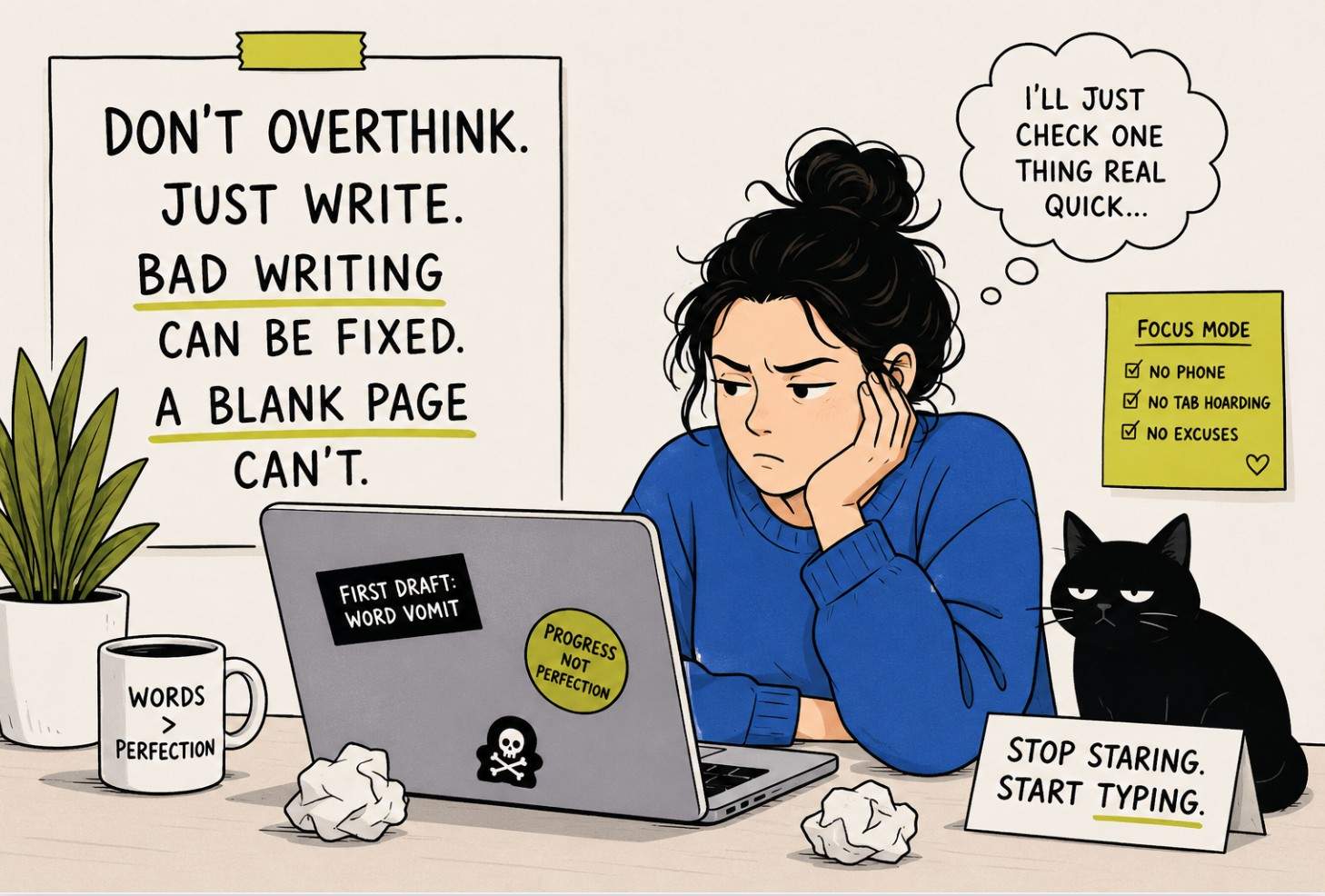
Stop Staring at Blinking Cursors Like They Personally Betrayed You
There is a very specific kind of suffering that only writers understand.You open a blank document with confidence. Maybe even arrogance. Today is the day, you think. Today the words flow effortlessly from your beautiful little genius brain.Then you type a title.Maybe half a sentence.Then suddenly you are reorganizing your desktop folders, checking the weather in a city you do not live in, and wondering if medieval peasants experienced burnout.Meanwhile, the cursor blinks at you. Mocking you. Patiently. Like a tiny vertical prison guard.Writing is weird because technically nothing is stopping you. You are not trapped under a car. You are not defusing a bomb. You literally just need to type words in a document. Yet somehow your brain reacts like you are being asked to perform surgery with oven mitts on.And the worst part? Most people make it slower.Not because they are bad writers. Because they accidentally turn writing into an Olympic-level overthinking competition.So if writing takes you fourteen business days and three emotional breakdowns, here are a few reasons why.And more importantly, how to stop.
You Keep Trying to Sound Smart
This one destroys more writing than bad grammar ever could.People sit down to write an email, article, or blog post and suddenly transform into a Victorian ghost lawyer.“Utilizing strategic communication initiatives…”Brother. You are asking Steve if he saw the attachment.Somewhere along the way, people got tricked into believing good writing means sounding intelligent. It does not. Good writing means being understood quickly.That is it.The fastest writers are usually the clearest writers because they are not wasting half their mental energy trying to sound “professional.” They just say the thing.Bad:
“Our organization aims to facilitate optimized collaborative engagement.”Good:
“We want people to work together without wanting to fight each other in Slack.”One of those sounds human. The other sounds like a LinkedIn post written moments before a nervous breakdown.Stop performing intelligence. Start communicating.Your writing speed will improve immediately.
You Are Editing While Writing
This is the equivalent of trying to drive a car while actively rebuilding the engine.You type one sentence.Then immediately: Reword it Delete half of it Change the tone Fix punctuation Wonder if “however” makes you sound annoying Reread the paragraph seven times Lose your train of thought entirelyCongratulations. You are now trapped in Editing Hell.Drafting and editing are different skills. One creates. One improves. Trying to do both simultaneously turns your brain into microwaved soup.Fast writers know first drafts are supposed to be messy.Messy is fine.Messy is normal.Messy means words are happening.You know what is not fixable? A blank page. That thing just sits there radiating judgment.Write ugly first. Clean it later.Nobody sees the rough draft except you and possibly the FBI after your laptop gets confiscated.
Your Introductions Are Too Dramatic
Writers waste an unbelievable amount of time trying to craft “perfect openings.”Meanwhile readers are out here skimming articles while standing in line at Target eating pretzels from the snack aisle.You do not need to write the next opening line of a Pulitzer-winning novel every time you draft a blog post.Just start.Seriously. Start badly if necessary.You can always rewrite the intro later once you know what the article is actually about.Most people treat introductions like ceremonial speeches before battle.“Since the dawn of humanity…”Relax, Shakespeare. The article is about productivity apps.The faster approach is brutally simple: Say the thing Explain the problem Keep movingReaders do not need a slow cinematic pan across the emotional landscape of your topic.They clicked because they want help, entertainment, or answers. Preferably before they get distracted by a video of a raccoon stealing cat food.
Your Brain Is Addicted to Distraction
Modern writing conditions are genuinely terrible.You are trying to focus while: Your phone vibrates every eight seconds Forty-three tabs are open Someone is arguing online about oat milk Your brain suddenly remembers an embarrassing thing from 2014And somehow people still wonder why writing feels difficult.Deep focus is not dead, but it is being hunted for sport.If you want to write faster, your environment has to stop behaving like a carnival designed by caffeine addicts.A few things that actually help: Put your phone in another room Close unnecessary tabs Write before checking email Stop “taking quick breaks” every six minutes Use full-screen modeYou do not need a perfect writing cabin in the mountains. You just need fewer tiny interruptions destroying your momentum.Because once momentum disappears, your brain suddenly decides folding laundry is a thrilling opportunity.
Stop Waiting to “Feel Inspired”
This one hurts. I know.People wait for inspiration like Victorian women waiting for sailors to return from war.Meanwhile professional writers are just sitting down and working even when their brain feels like expired yogurt.Inspiration is unreliable. Habits are faster.If you only write when you “feel creative,” your output will depend entirely on whether your brain decides to cooperate that day.Which it will not.Your brain is a raccoon. Stop negotiating with it.The trick is lowering the emotional stakes around writing.Not every sentence needs to be brilliant.
Not every paragraph needs literary fireworks.
Sometimes you just need functional words that communicate an idea without collapsing halfway through.Ironically, that is usually when the better writing shows up anyway.
The Secret Fast Writers Know
Here is the uncomfortable truth.Fast writers are not necessarily smarter.
They are not magical.
They are not sitting in candlelit rooms channeling the gods of literature.They just spend less time panicking.That is it.They trust themselves enough to keep moving.They know most sentences can be fixed later.
They know awkward drafts are part of the process.
They know clarity beats cleverness almost every time.And most importantly:
They stop worshipping perfection.Perfectionism is basically procrastination wearing expensive glasses.You are not writing a sacred historical document. You are trying to communicate with another human being before your attention span evaporates.That is all.
Final Thoughts Before You Open Another Tab
If writing feels painfully slow, the problem usually is not talent.It is friction.Too much editing.
Too much overthinking.
Too much pressure to sound impressive.
Too many distractions.
Too much waiting for the mythical moment when writing suddenly feels easy.Because honestly? Writing rarely feels easy while you are doing it.But it does get faster when you stop treating every sentence like it needs to survive public cross-examination.So open the document.Write the ugly draft.Ignore the blinking cursor acting like a disappointed parent.And for the love of all things holy, stop rewriting the first paragraph seventeen times before reaching the second one.