Fix Awkward Sentences
Awkward sentences usually happen when writers try way too hard to sound smart, professional, or “important.” Most bad writing can be fixed by using simpler words, shorter sentences, and deleting the weird corporate fluff your brain added for emotional support. Also, if your sentence sounds like it was written during a hostage negotiation between Grammarly and LinkedIn, it probably needs to go.
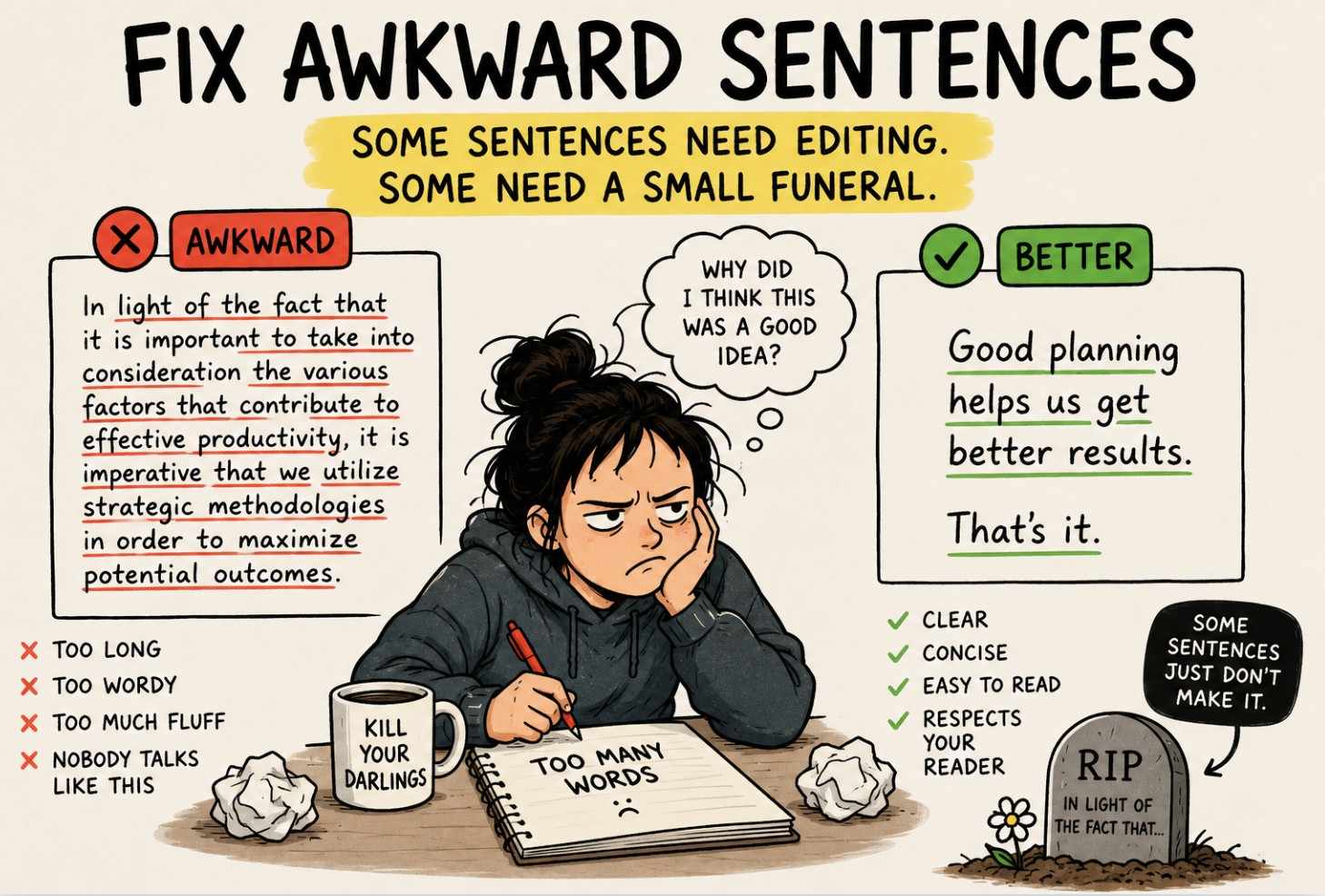
Some sentences need editing. Some need a small funeral.
There comes a moment in every writer’s life when they reread a sentence they wrote two days ago and physically recoil like they accidentally touched a hot stove.Not because the idea was bad.Because the sentence somehow turned into a twelve-mile grammatical hostage situation.We have all done it.You start with a simple thought:
“This meeting could have been shorter.”Then somehow your brain produces:
“It would potentially appear as though there may have been opportunities to optimize the duration-related efficiency outcomes associated with the meeting structure.”What happened there?Who wrote that?Why does it sound like a robot applying for middle management?Awkward sentences are fascinating because most of the time, the writer technically knows what they mean. The problem is the sentence took the scenic route through hell before arriving there.And unfortunately, readers are not patient tour guides.The second your writing becomes clunky, confusing, or exhausting, people leave. Mentally first. Physically shortly after.So let us talk about awkward sentences.
Why they happen.
Why your brain keeps creating them.
And when it is time to lovingly edit them versus quietly escorting them behind the barn.
Most Awkward Sentences Are Trying Too Hard
This is the big one.Awkward writing usually comes from effort. Not laziness.People twist sentences into pretzels because they are trying to: Sound smart Sound professional Sound poetic Sound academic Sound important Impress strangers on the internet for reasons that require therapyMeanwhile the strongest writing is usually the clearest.Good sentences do not flex.
They communicate.Awkward:
“In today’s rapidly evolving digital environment, individuals are increasingly seeking optimized methods of communicative engagement.”Human:
“People want clearer ways to communicate online.”One of these sounds like a normal person.
The other sounds like a consultant trapped inside a PowerPoint presentation.Complicated writing is not automatically intelligent.
Sometimes it is just exhausting.Readers should not need hiking equipment to reach the end of your paragraph.
Your Sentence Is Probably Too Long
Some writers fear periods like they are emotionally charged.So they keep adding: Extra clauses Side thoughts Unnecessary transitions Random commas Parentheses inside parentheses A sentence-shaped cry for helpAt some point your sentence stops being informative and starts resembling a train that lost its brakes three counties ago.Here is a useful rule:
If you run out of oxygen reading your sentence out loud, it probably needs help.Shorter sentences are easier to follow because human brains enjoy breathing.That does not mean every sentence should sound like a caveman wrote it.Variation matters.But many awkward sentences improve immediately when split in half like a suspiciously expensive restaurant bill.Example:Awkward:
“While attempting to complete the article, which had originally been intended as a short-form blog post but gradually evolved into something significantly longer due to excessive overthinking and continual revisions, I became increasingly frustrated.”Better:
“I tried to write a short blog post. Then I overthought everything and accidentally created a monster.”Cleaner.
Sharper.
Less emotionally exhausting.
Stop Using Five Weak Words Instead of One Normal One
Awkward writing loves unnecessary phrases.People write:
“At this point in time…”Just say:
“Now.”People write:
“Due to the fact that…”Just say:
“Because.”People write:
“In the event that…”You mean “if.” Calm down.A shocking amount of awkwardness disappears when you stop inflating sentences like decorative pool toys.Simple words move faster.
Readers trust them more.
And honestly, they make you sound more confident.Overexplaining sounds nervous.Clear writing sounds like you know what you are talking about.
Sometimes the Problem Is Rhythm
This part is harder to teach, but once you notice it, you cannot unsee it.Good writing has rhythm.
Awkward writing trips over itself.Read this sentence:“The article was written in a way that was intended to provide information that readers would potentially find useful in relation to improving writing skills.”Technically understandable.
Emotionally unbearable.Now this:“This article helps readers write better without sounding like malfunctioning office printers.”The second one flows because the rhythm changes naturally.
It moves.
Your brain does not have to drag it uphill.Awkward sentences often contain: Too many similar word lengths Too many filler phrases Repetitive structure Passive voice piled onto passive voice like wet laundryThe fix is usually reading your writing out loud.Your ears catch awkwardness faster than your eyes do.If a sentence sounds weird spoken aloud, readers will feel that weirdness too. Even silently.
Passive Voice Is Not Evil. But It Is Sneaky.
Every writing expert online talks about passive voice like it personally ruined their marriage.Passive voice is not always bad.But awkward writers tend to overuse it because it feels safer somehow.“The email was sent by me.”Why are we talking like medieval diplomats?Just say:
“I sent the email.”Passive voice creates distance.
Active voice creates clarity.Again, not every passive sentence is terrible. Sometimes it makes sense.But when your writing feels weak or awkward, passive voice is usually lurking nearby wearing sunglasses indoors.
Stop Worshipping “Professional” Writing
This one genuinely damages people.Corporate culture convinced an entire generation that professional writing should sound cold, bloated, and vaguely threatening.So now everyone writes emails like:
“Per my previous correspondence…”Just say:
“As I mentioned earlier…”Nobody talks like corporate emails in real life because if they did, they would be removed from parties.Professional does not mean robotic.Professional means: Clear Respectful Direct Easy to understandThat is it.The best writers sound human.Even lawyers with functioning personalities understand this now.Meanwhile some marketing departments are still out here “leveraging scalable communication synergies” like possessed LinkedIn demons.
Know When to Delete the Sentence Entirely
This is important.Sometimes editing is not enough.Sometimes the sentence has fought bravely, but its time has come.Writers get emotionally attached to sentences because they remember the effort behind them.Readers do not care about your effort.
They care whether the sentence works.A sentence can be: Grammatically correct Technically impressive Clever DetailedAnd still completely ruin the flow.If a sentence slows everything down, confuses readers, or sounds unnatural, delete it.Not every sentence deserves rehabilitation.Some need a respectful little funeral and immediate replacement.That is writing.
Final Thoughts Before You Commit More Sentence Crimes
Awkward sentences happen because writing is thinking in public.And unfortunately, human thinking is messy.The goal is not perfection.
The goal is clarity.You are not trying to sound like the smartest person alive.
You are trying to make another human understand you without developing a stress headache.So: Shorten bloated sentences Stop overexplaining Use simpler words Read things out loud Split giant thoughts into smaller ones Stop writing like a haunted HR manualAnd most importantly:
If a sentence sounds like it was assembled by committee during a gas leak, rewrite it.Your readers deserve better.
Honestly, so do you.