Develop Your Writing Voice
Most people do not struggle to find their writing voice because they lack personality. They struggle because they keep writing like nervous corporate interns trying to impress invisible English teachers. The best writing sounds human, confident, slightly weird in a good way, and like somebody who has actually spoken to another person before.
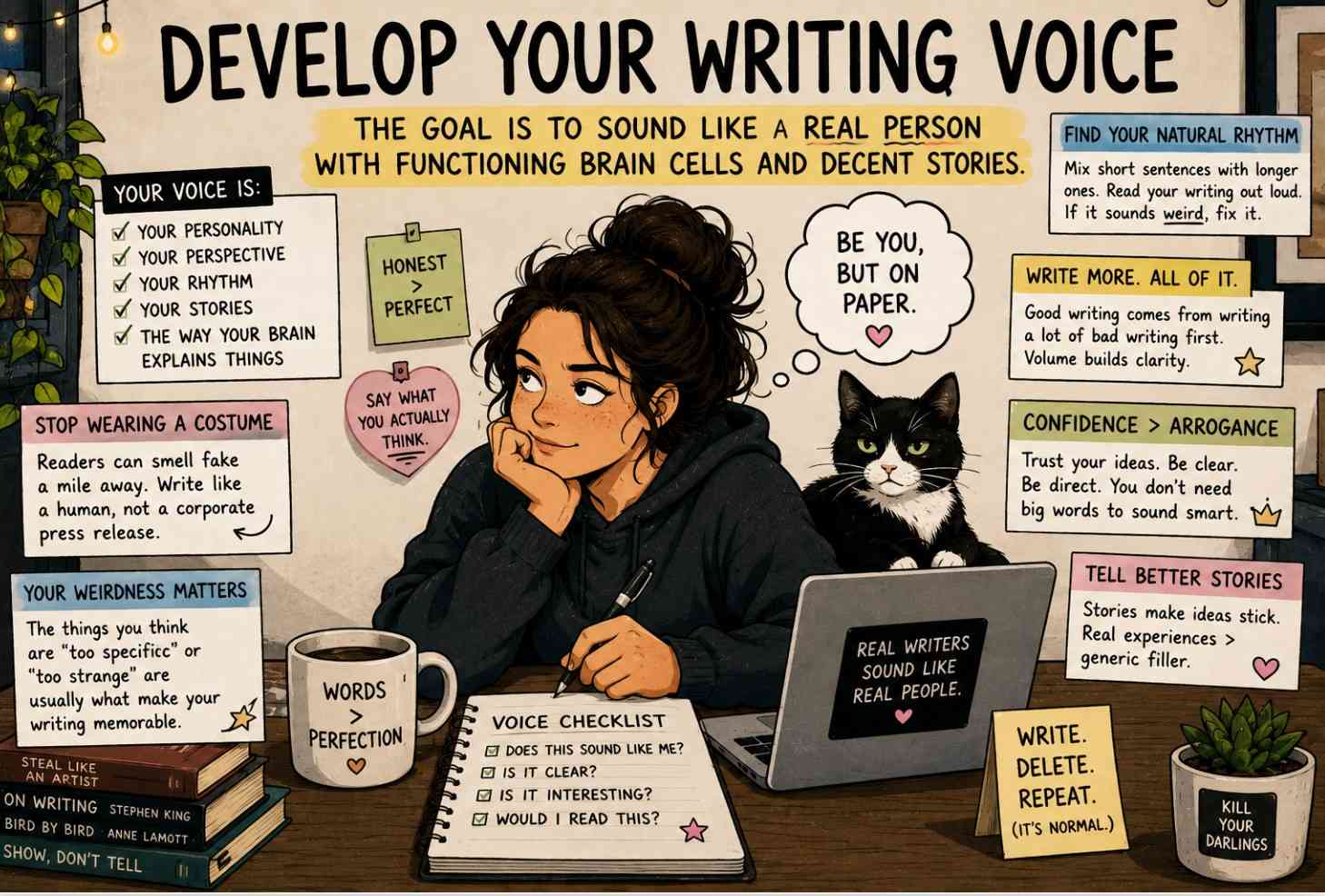
The goal is to sound like a real person with functioning brain cells and decent stories.
Every bad writer eventually asks the same question:“How do I find my writing voice?”Usually right after writing a paragraph that sounds like a malfunctioning LinkedIn influencer trapped inside a TED Talk.And honestly, fair enough.Developing a writing voice feels weirdly mysterious at first because nobody explains it properly. People talk about it like it is some magical artistic force that arrives one rainy evening while you journal in a coffee shop wearing a scarf.It is not.Your writing voice is basically: Your personality Your rhythm Your perspective Your sentence habits The specific way your brain naturally explains thingsThat is it.The problem is most people accidentally bury their real voice under layers of: Trying to sound smart Trying to sound professional Copying other writers Fear of sounding “wrong” Academic trauma from high school English classesSo instead of sounding human, they sound like a customer service chatbot applying for a management position.And readers can feel it immediately.You know that weird numb feeling you get reading certain articles online? Like the words technically make sense but somehow contain absolutely no life whatsoever?That is what happens when somebody writes without a voice.It is content.
Not communication.
Most People Write Like They Are Wearing a Costume
This is the biggest problem.The second people start writing publicly, they panic and become a completely different person.Someone who says things like:
“Utilizing innovative storytelling methodologies…”Meanwhile in real life they would simply say:
“I like telling stories.”Why are we cosplaying as corporate ghosts?People think “good writing” means sounding elevated.
Formal.
Important.But the writing readers actually remember usually sounds natural.Not sloppy.
Not lazy.
Just human.The internet already has enough robotic writing clogging up every corner of existence like digital cholesterol.Readers are starving for personality.Not fake personality either.
Actual personality.The kind where somebody sounds like a person instead of an HR memo written during a hostage situation.
Your Voice Already Exists. You Just Keep Smothering It.
This part is important.You do not invent a writing voice from scratch.You uncover it.Pay attention to how you naturally: Tell stories Explain things Joke around Argue Describe frustrating experiences Text friends when mildly irritatedThat rhythm?
That tone?
That weird specific way you phrase things?That is the beginning of your voice.Most strong writers are basically just exaggerated versions of themselves on the page.Not fake.
Not manufactured.
Just clearer and more intentional.The reason some writers feel instantly recognizable is because their voice stays consistent.You could remove their name entirely and people would still know who wrote it.That only happens when somebody stops trying to sound like “a writer” and starts sounding like themselves.
Stop Copying Writers You Admire
I know.
This sounds rude because everybody copies writers at first.That part is normal.You read somebody brilliant and suddenly your next paragraph mysteriously sounds exactly like them after three coffees and a head injury.It happens.But eventually you have to move past imitation.Otherwise your writing becomes a strange Frankenstein monster made entirely of borrowed styles stitched together with insecurity.You can learn from writers without becoming their haunted clone.Study: Their pacing Their clarity Their storytelling Their structureBut do not steal their personality.Readers can sense imitation the same way people can sense forced small talk at networking events.Painfully.
Voice Comes From Confidence
Not arrogance.
Confidence.There is a difference.Writers with strong voices trust themselves enough to: Use simple language Be direct Say what they actually think Sound conversational Take creative risks Leave room for personalityWeak writing usually sounds scared.Like somebody desperately trying not to be judged by invisible English teachers floating around the ceiling.And honestly, a lot of that fear comes from school.School writing trains people to: Overexplain Sound formal Kill personality Avoid risk Write for grades instead of humansThen later everyone wonders why their writing feels lifeless.Because somewhere along the way, personality got treated like a formatting error.
Good Writing Voice Has Rhythm
This part matters more than people realize.Voice is not just vocabulary.
It is rhythm.Some writers sound sharp and fast.
Some sound reflective.
Some sound chaotic in an entertaining way.
Some sound conversational and warm.That rhythm comes from sentence variety.For example:Short sentences create punch.Longer ones slow things down and create more thoughtfulness, assuming they do not spiral into an unreadable grammatical swamp filled with unnecessary commas and emotional regret.See the difference?Rhythm shapes personality.Good writers know how to vary pacing naturally.
That movement keeps readers engaged.Flat writing often sounds flat because every sentence is built exactly the same way like identical suburban houses built by exhausted developers.
Your Weirdness Is the Interesting Part
This is the part people resist most.The specific things that make your writing feel different are usually the things you are trying hardest to hide.Your humor.
Your perspective.
Your observations.
Your slightly unhinged metaphors.
Your storytelling instincts.That stuff matters.Nobody remembers writers because they sounded perfectly polished.People remember writers because they sounded alive.Think about your favorite writers.
Odds are they: Have opinions Sound distinct Use unusual phrasing Tell specific stories Feel humanPerfection is forgettable.Voice is memorable.
You Need to Write More Bad Stuff
Unfortunately there is no shortcut around this.Voice develops through volume.Not theory.
Not courses.
Not staring thoughtfully out windows pretending to be creative.Writing.A lot of writing.Bad writing especially.Because your voice gets clearer every time you: Experiment Fail Rewrite Notice patterns Learn what feels natural Learn what feels fakeMost people quit before their voice fully develops because they panic during the awkward phase where everything feels cringe.Which is tragic because every good writer has a graveyard full of terrible drafts hidden somewhere.That is normal.The bad writing is part of the process.
Unfortunately.
Final Thoughts Before You Go Rewrite Your Entire Personality
Developing your writing voice is not about becoming somebody else.It is about removing all the weird artificial layers between your brain and the page.The strongest writing usually sounds like: A smart person Explaining something clearly With confidence Personality Rhythm Actual human thoughtsNot a corporate brochure.
Not a textbook.
Not a motivational LinkedIn post written by a man named Brent who “hustles.”Just a real person with functioning brain cells and decent stories.Which honestly should not be this rare online, but here we are.