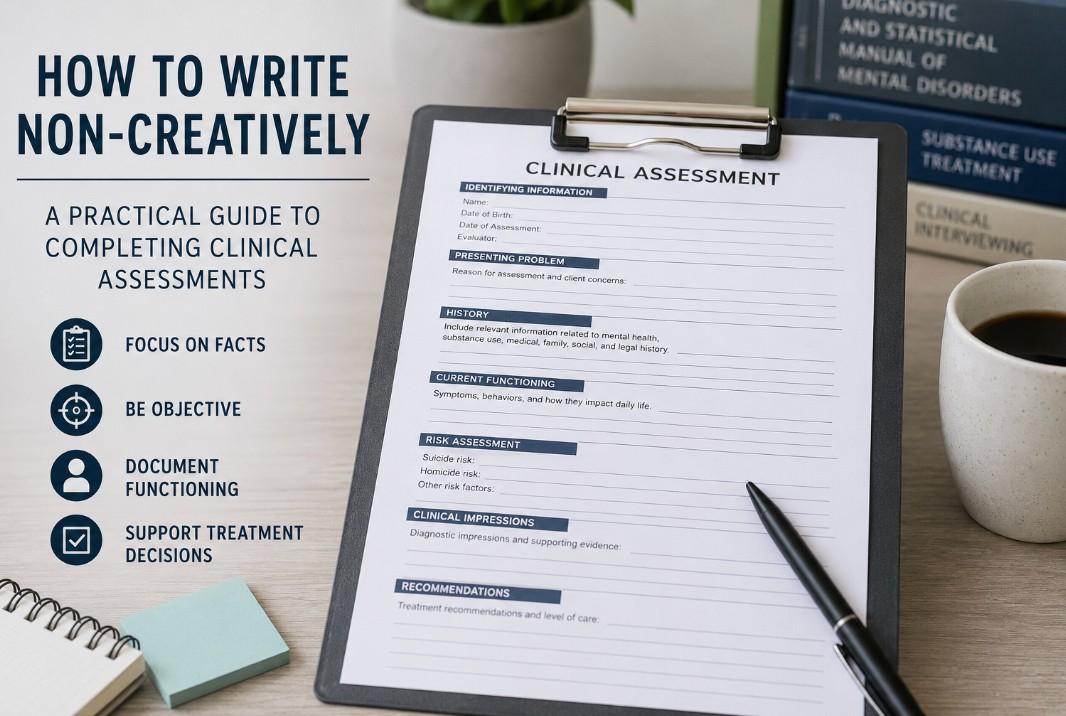
How to Write Non-Creatively: A Practical Guide to Completing Clinical Assessments
Clinical documentation is one of the few forms of professional writing where creativity can actually become a liability. While creative writing encourages self-expression, storytelling, and artistic language, clinical assessments require the opposite approach. The goal is not to entertain, persuade, or impress. The goal is to accurately document information, support clinical decision-making, and communicate findings clearly to other professionals.
Many new clinicians enter the field after years of academic writing, where originality and voice are often rewarded. As a result, they sometimes approach assessments as if they are writing essays. This can lead to vague language, unnecessary complexity, unsupported conclusions, and documentation that fails to serve its intended purpose.
The best clinical assessments are often the least creative. They focus on facts, observations, client statements, and measurable information. They provide a clear picture of the client's functioning without exaggeration or speculation. Whether you are completing a substance use assessment, biopsychosocial evaluation, mental health intake, or treatment recommendation, learning how to write non-creatively can improve both the quality and effectiveness of your documentation.
Understand the Purpose of the Assessment
Before writing any assessment, it is important to understand why the document exists. Clinical assessments are not academic papers, journal entries, or narratives. They serve a specific professional function.
Assessments help establish a baseline of functioning, identify presenting concerns, support diagnoses, guide treatment planning, communicate information to other providers, and satisfy legal or regulatory requirements. In many cases, they may also be reviewed by insurance companies, courts, licensing boards, supervisors, or auditors.
Because assessments serve multiple audiences, clarity becomes essential. Every sentence should contribute useful information. Readers should be able to quickly understand the client's history, current concerns, level of functioning, and treatment needs.
When clinicians lose sight of the assessment's purpose, they often begin adding unnecessary descriptions or attempting to make the document sound more sophisticated than necessary. Effective assessment writing focuses on communication rather than style. The goal is simply to provide an accurate and professional record of the client's situation.
A useful question to ask while writing is: Would another clinician be able to understand this client's needs after reading this assessment? If the answer is yes, the documentation is likely accomplishing its purpose.
Document Facts Instead of Stories
One of the most important principles of non-creative writing is focusing on facts rather than narratives. Clinical assessments should describe what the client reported, what was observed, and what evidence supports the conclusions being made.
Consider the difference between these two statements:
"The client appeared trapped in a destructive cycle that has taken control of every aspect of life."
Versus:
"The client reported daily alcohol use, recent employment difficulties, and ongoing relationship conflict related to substance use."
The second statement provides objective information that can be evaluated and verified. It avoids dramatic language while still communicating significant concerns.
Clinicians should strive to document specific details whenever possible. Include information regarding frequency, duration, severity, context, and consequences. Rather than stating that a client struggles with anxiety, document how often anxiety occurs, how long symptoms have been present, and how those symptoms affect daily functioning.
Facts create stronger assessments because they allow readers to draw informed conclusions based on documented evidence. Stories invite interpretation. Clinical documentation should minimize interpretation whenever possible.
Use Clear, Direct, and Objective Language
Many clinicians mistakenly believe that professional documentation requires complicated vocabulary and lengthy sentences. In reality, effective assessment writing is usually straightforward and easy to understand.
Simple language improves communication between providers and reduces the likelihood of misunderstandings. The purpose of documentation is not to demonstrate intelligence. The purpose is to communicate information accurately.
For example, instead of writing:
"The client demonstrated a pervasive inability to effectively regulate emotional responses during periods of psychosocial stress."
A clearer statement would be:
"The client reported difficulty managing emotions during stressful situations."
Both statements communicate a similar idea, but the second version is easier to read and understand.
Objectivity is equally important. Avoid emotionally charged language, dramatic descriptions, and unsupported conclusions. Terms such as rock bottom, spiraling out of control, emotionally shattered, or battling inner demons may sound compelling, but they provide little clinical value.
Instead, describe observable behaviors, reported symptoms, and measurable impairments. Objective language creates documentation that is more professional, defensible, and clinically useful.
Separate Observation, Report, and Interpretation
Strong clinical assessments distinguish between three different types of information: client reports, clinician observations, and clinical interpretations.
Client reports consist of information provided directly by the client. Examples include descriptions of symptoms, substance use history, relationship concerns, or personal experiences.
Clinician observations include information gathered during the interview. Examples might include appearance, affect, orientation, speech patterns, behavior, and participation during the assessment process.
Clinical interpretations involve professional judgments based on the available information. Diagnoses, treatment recommendations, and clinical impressions generally fall into this category.
Problems arise when these categories become blended together. For example, writing that a client uses substances because of childhood trauma may represent speculation unless there is clear evidence supporting that conclusion.
A more objective approach would be to document that the client reported a history of childhood trauma and identified emotional distress as a trigger for substance use. This approach presents the information without assuming causation.
Maintaining clear distinctions between reported information, observed behavior, and clinical interpretation strengthens documentation and reduces the risk of inaccurate conclusions.
Focus on Functioning and Treatment Needs
Clinical assessments should do more than simply list symptoms. They should explain how those symptoms affect the client's daily life.
A diagnosis alone rarely tells the full story. Two clients may meet criteria for the same diagnosis while experiencing vastly different levels of impairment. As a result, documenting functional impact becomes critical.
When describing concerns, consider how symptoms affect important areas of life, including employment, education, relationships, housing, physical health, finances, and legal involvement.
For example, instead of documenting that a client experiences depression, explain how depressive symptoms affect work attendance, motivation, self-care, social interaction, or daily responsibilities.
Functional impairment often provides the strongest justification for treatment recommendations. It also helps treatment providers identify appropriate interventions and goals.
Recommendations should be directly supported by assessment findings. If intensive outpatient treatment is recommended, the assessment should clearly explain the factors supporting that level of care. Readers should be able to follow the logic connecting assessment findings to treatment recommendations without having to guess.
The strongest assessments create a clear link between symptoms, impairment, and treatment needs.
Let the Data Speak for Itself
One of the most valuable skills clinicians can develop is the ability to trust the information being presented. There is often no need to embellish, dramatize, or enhance the client's story.
If a client reports daily substance use, multiple DUI arrests, family conflict, financial problems, previous treatment episodes, and unsuccessful attempts to quit, the seriousness of the situation is already apparent. Additional dramatic language adds little value.
Similarly, if a client reports severe anxiety that interferes with employment, relationships, and daily functioning, readers can appreciate the significance of the problem without emotional descriptions or elaborate narratives.
Good assessment writing allows the facts to speak for themselves. The clinician's role is to organize, clarify, and document information accurately rather than transform it into a story.
This approach not only improves professionalism but also creates documentation that is easier to defend during audits, legal proceedings, supervision, and peer review. Accurate, objective, and evidence-based documentation remains the gold standard across behavioral health settings.
For professionals who conduct DOT return-to-duty assessments and related evaluations, maintaining objective documentation standards is especially important. Those seeking information regarding the SAP evaluation process can benefit from understanding how structured assessments support compliance, treatment planning, and regulatory requirements.
Conclusion
Writing non-creatively is one of the most important skills a clinician can develop. Effective assessments prioritize accuracy over artistry, facts over narratives, and clarity over complexity. By understanding the purpose of documentation, focusing on objective information, using direct language, separating observations from interpretations, documenting functional impairment, and allowing the data to speak for itself, clinicians can create assessments that are both professional and clinically valuable.
The best clinical documentation is rarely memorable because of how it sounds. It is memorable because it communicates exactly what needs to be communicated, nothing more and nothing less.